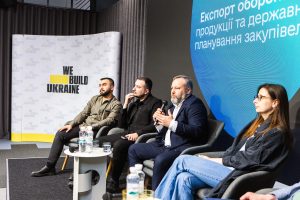
These were the key takeaways from the conference “Ukrainian Energy: Strategies for Recovery and Development”, organized by the analytical center We Build Ukraine on September 16. The discussions focused on the needs of market players, factors stimulating or hindering investments, and the market’s readiness for a full-scale, “one-day” integration with the EU to lay the groundwork for a transparent, competitive, and economically oriented energy policy.


Key Statements from Conference Participants
In her opening remarks, Katarina Mathernova, EU Ambassador to Ukraine, emphasized that the rapid synchronization of the Ukrainian and Moldovan grids with continental Europe has become a symbol of transformation. The next phase—recovery, decentralization, and market integration—should ensure resilience and attract investment to the Ukrainian energy market.
“In the early days of the full-scale aggression, we worked together to synchronize the Ukrainian and Moldovan grids with continental Europe—this didn’t happen by itself, but it was a groundbreaking step. Today, our efforts are focused on the recovery and resilience of the energy system, which we are coordinating with the U.S. and other partners, having already mobilized over $3 billion in support. In parallel, we are advancing three key areas: reforms and liberalization, market integration, and investments, including guarantee instruments for the private sector and support for ‘green’ projects,”
She added that specific legislative steps are expected in the fall, while the EU will continue to invest in the public sector—including loans for gas procurement for “Naftogaz” and support for “Ukrenergo” and regional energy companies. The EU will also stimulate distributed generation, renewable energy, and energy storage projects to create a resilient, integrated, and liquid market capable of withstanding future attacks and attracting investment.


According to Oleksandr Kubrakov, Head of the We Build Ukraine analytical center, the energy market is crucial for the entire economy. High prices can hinder production and lead to business closures, while low prices stimulate development. Therefore, policy must account for the full interdependence of sectors amid ongoing attacks on infrastructure.
“The energy market is one of the most important because it affects every sector of the economy. Despite the strikes on infrastructure, thanks to the support of the European Commission, we are seeing real investments in ‘green’ energy: there are already nearly 4 GW of wind power in the pipeline alone, and households and small and medium-sized businesses have added about 1.5 GW of distributed solar generation,”
Bálint Silhavy, Senior Expert at BCG in Central and Eastern Europe, highlighted that the war has radically changed the structure of energy supply and demand. Ukraine will likely remain an importer for the next 15–20 years, with a potential return to exporter status after 2040, provided there is a large-scale renewal of generation, system decentralization, and accelerated economic electrification. Energy, he said, may not be the most productive sector, but it underpins the entire economy.
“Our vision is rapid electrification (with a share of electricity reaching about 30% by 2040), with nuclear power remaining the base, and wind and solar growing rapidly, while decentralization enhances security. To realize this scenario, Ukraine needs approximately €200 billion in investments by 2040 for new and modernized capacities, networks, and the gas segment—primarily from international financial institutions and private capital,”
He believes that rising electricity consumption will be accompanied by a reduction in the use of gas and coal, decreased reliance on LNG, and the development of flexible balancing capacities. At the same time, competitiveness will be ensured by a diversified portfolio of sources, transparent rules for investors, and the systematic use of gas in the economy—this way, Ukraine can become one of the key players in the European energy market.


The event’s moderator, energy expert Victoria Voytsitska, noted that Ukrainian energy is facing a critical situation where any delay in reforms threatens economic and national security. Despite constant attacks and a lack of investment, Ukraine’s energy sector has significant potential for recovery and integration into European energy markets.
“To achieve this, decisive measures must be taken urgently: ensure the true independence of the energy regulator; liberalize markets; and ensure stable, transparent, and predictable rules. These changes are key to the country’s recovery and its path to the EU, making them not just an issue for the energy sector, but a fundamental basis for strengthening the state,”
Gas and Heat Market: What Should the Development Strategy Be?
According to Oleksandr Slobozhan, Executive Director of the Association of Ukrainian Cities, the debts of heat and water supply companies for electricity arose due to economically unjustified tariffs and the lack of compensation for the tariff difference from the state budget. The officially confirmed debt to these companies already exceeds 67 billion UAH. This situation creates a risk of heating and water utilities shutting down in the event of electricity disconnections, posing a real threat of leaving communities without heat and water.


“If the tariff difference is not covered, we risk entering the heating season without heat and water. We propose that ‘Naftogaz’ solve this problem without live funds by clearing 45 billion UAH to ‘unfreeze’ the system, as the draft state budget lacks a subvention for the tariff difference and its sources of coverage. It is also unacceptable to allow the disconnection of water utilities in the case of a disputed debt that is being considered by a court without a court decision—this could lead to the cessation of water and heat supply,” he stressed.
Andriy Kobolyev, co-founder of the investment company Eney, noted that traditional gas deposits are gradually being depleted, leaving smaller, deeper, or lower-permeability reservoirs. He added that while it is possible to temporarily accelerate the output from an existing traditional field by drilling a few extra wells, he considers this a misguided strategy.
“This will increase production for a short period. But in terms of gas and oil extraction, you are doing a disservice to the future of the company and Ukraine, because these wells are not actually needed.”
Kobolyev emphasized the need to move towards unconventional resources. To extract resources in an economically viable way, Ukraine must look into tight gas and offshore fields.
“Tight gas is a promising direction for the country. And it’s a promising direction for private companies too. One of the key elements of our strategy is to attract technological partners, primarily American extraction companies, to create partnerships with the state and state-owned enterprises to develop this direction.”
According to Oleksiy Zayets, CEO of Smart Energy Group, 2025 has been the most difficult year for the gas production industry due to unprecedented attacks. To confidently get through the winter, alongside gas imports, it is critically important to restore stable production in eastern Ukraine, considering network constraints, and to provide the industry with resources—money, time, and people.
“Before the war, we produced over 1 million m³ daily; now, it’s about 100,000 m³. Due to an imperfect sanctions policy, two of our production assets are shut down—this is a loss of approximately 270,000 m³ per day and about 90 million m³ lost during the heating season. We need three things: production security, stable and predictable rules and taxation, and the ability to sell gas at market rules and prices,”
In his opinion, without the political will to untie the “sanctions knot” and guarantee stable rules, capital investments will be reduced (the investment program has been cut from 3.2 billion to 200 million UAH). At the same time, preserving the gas production industry is a key prerequisite for the future restoration of the country’s industrial potential.


Yevhen Bondarenko, Executive Director of DTEK Naftogaz, believes that the main challenge this winter is 100% demand coverage amid infrastructure strikes.
The response must be work safety and active investment in technology, exploration, and drilling. Ukraine has one of the largest gas reserves in Europe (after Norway), so increasing its own production can improve the import-export balance. Since the start of the war, not including this year’s investments, the company has invested over 12 billion UAH in new wells (over 60% of which is exploration drilling) and, as the largest private producer (40–45% of the private segment, about 10% of the country’s production), is maintaining output.
“In February and March, we also survived infrastructure strikes, so safety is critical. But despite the war, the industry must do its job—produce: invest in drilling, exploration, and infrastructure, and develop partnerships with private and state companies, including under PSAs. For foreign players to come, the country needs simple instruments for repatriating dividends or a share of the production—then investors’ funds will become a reality,”
Andriy Bychkov, Director of SOCAR Trading House, noted that from 2017 to 2021, the company supplied almost 1 billion m³ of gas to Ukraine annually and was one of the first to organize the import of American gas through Polish ports, proving in practice that energy independence from Russia is based on diversification, not on replacing one dependency with another.
He emphasized that Ukraine’s strategy must combine imports from various directions with actively increasing its own production while creating clear mechanisms for global investors to enter. SOCAR, one of the few international energy companies that remained in the country, is ready to invest and be a partner to help Ukraine get on a trajectory of energy autonomy and, with an ambitious plan, become a net exporter.
According to Oleh Khomenko, CEO of the Ukrainian Agri-Food Council (UCAB), although the agricultural sector is a minority consumer of gas, certain parts of it are critically sensitive. Grain drying requires about 10 m³ of gas per ton (corn alone requires approximately 300 million m³), gas accounts for ≈50% of the cost of sugar, and up to 80% of the cost of fertilizers. Consequently, the total consumption of the agricultural sector is about 1 billion m³ per year. Amid price fluctuations and gas shortage risks, companies are forced to invest in energy efficiency and diversify energy sources, develop biogas generation, and work with biomass to ensure the energy independence of each production unit, with the goal of maintaining the profitability and competitiveness of harvested crops on the global market in the future.
“We are not as gas-intensive as heavy industry, but gas determines the competitiveness of agricultural products: ~10 m³ per ton for grain drying, up to 50% of gas in the cost of sugar, and up to 80% in fertilizers. In total, the agricultural sector consumes about 1 billion m³ per year. Without an affordable resource, we risk our harvest, so our answer is to invest in energy efficiency by using available biomass and producing biogas,”
What is Needed to Improve the Investment Climate in the Electricity Market?
According to Volodymyr Kudrytskyi, co-founder of “Nedjen” and former Head of the Board of “Ukrenergo”, Ukraine, along with countries in Central and Eastern Europe, is in a “high-price zone” for electricity because the marginal price is determined by thermal generation. Therefore, a real reduction in prices is only possible by changing the energy mix—gradually replacing Soviet thermal generation with a combination of renewables, energy storage systems, and other flexible capacities.
“We no longer sell kilowatt-hours on the market; we sell a service—the schedule a client needs. A real price reduction will come not from slogans but from a change in the mix: displacing thermal generation with solar, wind, and batteries. Despite numerous public announcements and discussions, we have just over 300 MW of operational energy storage systems. My estimate is that structural changes will take 4–5 years,”
He added that institutional flaws—PSOs for “Energoatom” and “Ukrhydroenergo”, price caps, and regulatory inconsistencies—distort pricing, and “fixing” them would yield approximately 10–15% of the potential for a price reduction. To achieve full market integration with Central and Eastern European countries, these barriers must be removed while simultaneously updating the energy mix. However, he considers the main regulatory problem to be the lack of independence of the regulator as an institution.
Oleksandr Kalenkov, President of “Ukrmetalurgprom”, noted that the investment attractiveness of the electricity market directly depends on the consumer. Before the war, the mining and metallurgy complex consumed up to 58% of industrial electricity. Now, high prices in Ukraine (in August, about €111/MWh compared to ~€93/MWh in CEE countries) and import restrictions due to insufficient cross-border transmission capacity undermine competitiveness. This is critical for energy-intensive industries: the share of electricity in the cost of ferroalloys reaches 40–60%, and at “ArcelorMittal Kryvyi Rih” it has increased from approximately 7% to 20%.
“We are not asking for preferences; we are asking for a market: access to imports, long-term contracts for cross-border transmission and with ‘Energoatom’, and transparent, professional work from the NCREMC with cost verification. As in the EU, a portion of the ‘green’ surcharge should be returned to energy-intensive consumers—otherwise, fines of hundreds of thousands of hryvnias will not compensate for the losses, and the risk of shutdowns at companies like ‘ArcelorMittal Kryvyi Rih’ will trigger a domino effect from ‘Ukrzaliznytsia’ to local budgets,”
He is convinced that the state must ensure predictability and fairness: increase and effectively distribute cross-border capacity, stimulate long-term contracts, consider mechanisms for returning a portion of payments for renewables to energy-intensive exporters, and strengthen the institutional independence of the NCREMC. This, Kalenkov noted, would maintain demand, provide clear signals to investors, and stabilize the generation market.
Dmytro Yehudin, COO of DTEK Energy, stressed that Ukrainian energy is facing unprecedented challenges—massive attacks, destruction of capacities, and human losses. Since the start of the full-scale invasion, the company’s thermal power plants have suffered over 200 strikes, resulting in 90% of generating capacities being destroyed or damaged by the summer of last year.
Despite this, DTEK Energy is not only restoring the energy system but also investing in the future. In 2022–2024, the company directed almost 28 billion UAH towards repairs of thermal power plants and coal mining, proving its ability to ensure resilience even in the most difficult conditions.
Yehudin emphasized that the energy transformation must happen in stages to avoid price shocks for consumers. “Our task is to maintain resilience today and lay the foundation for modernization and integration with Europe,” he said. Currently, DTEK Energy’s priority remains restoring capacity. But the company sees prospects for a gradual transition from coal to modern combined-cycle gas turbine power plants, the development of long-duration energy storage systems in the medium term, and the exploration of SMR (small modular reactor) technologies to replace coal blocks as part of a long-term strategy.

According to Oleksiy Orzhel, Head of the Kyiv Office of the Energy Community Secretariat, the development of the electricity market and the emergence of new consumers—from metallurgy to data centers and electric transport—require new distributed generation and rapid integration with the European market through market coupling and the development of cross-border networks.
“Our realistic path is to join the European electricity market. To do this, we must adopt the ‘Electricity Integration Package’ by the end of the year, strengthen the regulator’s independence, and simplify the connection of new capacities. However, it is not about the process of negotiations on how to implement European energy legislation to unite the markets; it is primarily about the legislation fully complying with European rules. This, and ultimately market coupling, will open up the liquidity of European markets, long-term PPAs, and investments. This will make it possible to build networks and generation right now, even in the difficult conditions of war,”