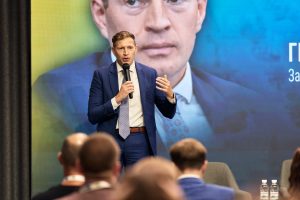
The event was attended by Alain Baron, Team Leader at the European Commission’s Directorate-General for Mobility and Transport, as well as representatives from international financial institutions (the World Bank, EBRD, EIB, IFC) and expert organizations. Their shared goal was underscored: to transform Ukraine into a fully-fledged multimodal logistics hub of the united Europe.


Oleksandr Kubrakov, Head of the We Build Ukraine think tank, noted that amidst the war and the new geopolitical reality, Ukraine must rethink its own transport system and adapt it through institutional reforms.
Key Conclusions and Theses from the Event:
- Forming a New Logistics Architecture: Participants emphasized that this task is not merely the legal alignment of Ukrainian legislation with European law, but a strategic stage—the formation of a new logistics architecture of Europe as a whole, of which Ukraine is an integral part.
- Need for a Clear Strategy: The necessity of developing a real, actionable strategy for the transport sector, along with detailed programs for sub-sectors, was highlighted. This includes the development of port infrastructure, railways, border crossing points, multimodal transport, and airports.
- Two Levels of Work: Analytical work on European integration must encompass:
- Analysis of Ukrainian legislation for compliance with the acquis (body of EU law).
- Defining development priorities and analyzing the historical context to strengthen Ukraine’s negotiation position.


Key Recommendations for a Competitive System:
The roundtable featured the presentation of a study that serves as an analytical basis, a practical guide, and a tool for political dialogue between Ukraine and the EU. Key recommendations include:
- Rail Transport: Implementing interoperability based on European standards (EU Directive 2016/797) and launching the ERTMS system on priority TEN-T sections to ensure seamless movement.
- Maritime and River Transport: Market liberalization, ensuring transparent tariff setting, and the full digital integration of Ukrainian ports (Chornomorsk, Reni, Izmail) into the common EU digital ecosystem (Port Community System).
- Multimodality and TEN-T: Integrating key logistics nodes (Lviv, Uzhhorod, Chop, Kovel) into the TEN-T Extended Core Network and strategically reinforcing the Rhine-Danube Corridor.
- Road Tolls: Introducing a single digital eToll system, compatible with EETS, for transparent financing of infrastructure recovery under the “user pays” principle.
Path Forward
Participants confirmed that harmonization with EU law opens access to instruments like CEF Transport, the Ukraine Facility, and resources from international financial institutions.


The next steps identified are: preparation of Ukraine’s official negotiation position, development of a detailed roadmap for legal harmonization, and the launch of pilot digital solutions in key sectors.
“Ukraine must move from the status of a partner who merely adapts legislation to that of a nation who co-creates EU policy in the transport sector. We aim not to be the periphery of the European space, but its central element—a logistics, technological, and digital hub,” said Anna Yurchenko,