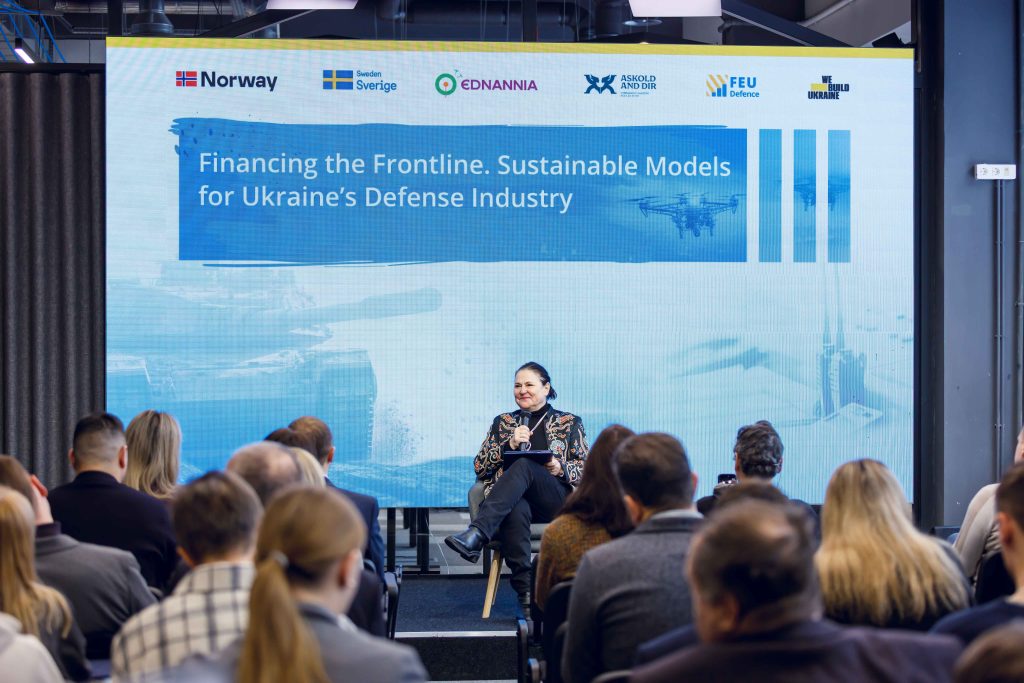
These were the key takeaways from the discussion “Frontline Financing: Sustainable Models for Ukraine’s Defense Industry,” organized by the We Build Ukraine analytical center and FRU Defense, with support from the Askold and Dir Fund, administered by ISAR Ednannia as part of the “Strong Civil Society of Ukraine – Driver of Reforms and Democracy” project, funded by Norway and Sweden.
High Potential, High Precision Implementation
Yaroslav Azhnyuk, founder of The Fourth Law, suggested viewing Ukrainian DefenseTech as a strategic advantage that must be converted into long-term human, institutional, and industrial capital. He emphasized that Ukraine is unique in having real-world experience in modern warfare, allowing it to become a major player that provides security not only for itself but for the entire free world for decades to come.
“However, for this potential to be realized, structural reforms in how the state interacts with the sector are needed to open the flow of global financial and human capital to Ukraine,”
Participants specifically highlighted that Ukraine’s advantage in drones is not a sign of lacking capital for other weapons, but rather a manifestation of a different approach to innovation. Olena Dushenok, Head of Development at SkyFall, recalled hearing a thesis from European partners that “Ukrainians fight with drones because they have no money.” In her view, the reality is different.
“Ukrainians fight with drones because we have talented engineers, understanding, and vision. But in a war of technology, it is vital not to relax: a new weapon must be released every three months, and Ukraine must stay focused on fighting the external enemy rather than looking for internal betrayals,”
Ihor Fomenko, head of FRU Defense, spoke about the scale of the sector and the issue of underutilized production. According to him, before 2022, there were about 300 defense enterprises in Ukraine; today, there are 900 in the Ministry of Defense registries alone and over 2,500 teams in startup registries. Employment in the industry has grown from approximately 80,000 to over 300,000 people, with production capacity reaching about $35 billion.
“The problem lies elsewhere: average production utilization is around 40%. This pushes enterprises out of the market or forces businesses to shrink, which is dangerous for the defense capabilities of both Ukraine and the EU,”
Investments Requiring Clarification
Perry Boyle, Co-founder & CEO of MITS Capital, insisted on the specific role of foreign capital. According to him, investors enter the sector to help push Russia out of Ukraine and reduce risks for frontline European states. However, he added, clear rules and signals from the state are critical.
“Even I sometimes lack a clear understanding of how these funds will reach the manufacturers. Clear messages from the Ukrainian government would be very valuable. Yes, the EU needs Ukrainian solutions and experience, as deterring Russia is a matter of long-term security. But now, the Government needs to provide clear explanations and guarantees,”
Yaroslav Azhnyuk emphasized that while the government has cited approximately $120 million in DefenseTech investment since the start of the full-scale invasion, this is very little on a global scale—especially for R&D and fundamental areas like AI or missile technology.
“Western investors are wary of companies whose primary customer is the Ukrainian Ministry of Defense: in the event of a truce, they fear a sharp drop in revenue. At the same time, the world is entering a massive rearmament cycle for decades to come, and this should change the attitude toward DefenseTech investments,”
Exports and Intellectual Property
These promising leads only make sense if barriers are overcome—specifically the opaque approach to exporting Ukrainian weaponry and resolving intellectual property issues between Ukraine and partner countries, which currently causes talent and capital to migrate to foreign companies.
Olena Dushenok described how foreign companies, despite large budgets, often come to Ukraine with solutions that simply do not work without access to the actual battlefield. She cited examples of partnerships where foreign developers integrate their solutions into Ukrainian platforms to gain “combat-proven” status: if a technology works at the front, it is easier to promote globally.
“However, there are bureaucratic and regulatory traps on both sides: Ukrainian manufacturers must pass SSEC (State Service for Export Control) procedures, while foreign entities often operate under peacetime regulations where approvals can take months or even a year,”
Perry Boyle stressed that for the sector’s sustainability, Ukraine needs international revenue and investment risk mitigation tools. He cited Danish partners who have funds and understand the threat but lack a sufficient defense industry, and are thus ready to support production consolidation in Ukraine. However, he believes the state must do its “homework”: currently, Ukraine cannot guarantee long-term contracts, the export of surplus products, or the withdrawal of dividends.
“The current 40% utilization is not due to a lack of need at the front, but a lack of financial resources. Export could be a tool to preserve the industry, though currently, everything is needed for the security and defense forces,”
Avoid Arrogance Toward Partners
According to MITS Capital co-founder Anton Melnyk, it is crucial for the Ministry of Defense to prioritize the “window of opportunity,” particularly regarding exports and ecosystem development. Meanwhile, Azhnyuk warned against “self-complacency” and acting superior toward partners just because Ukraine has vast practical experience.
“It is important not to think we have an advantage just because we have practical experience and they don’t. Urgency is what matters most. There are signals that should be taken as warnings: specifically, restrictive decisions regarding components in the US, and plans by foreign manufacturers to launch mass production of analogues to famous strike UAVs,”
In his view, without rapid changes, Ukraine risks losing the chance to become the “Florence of DefenseTech”—a chance that would define Ukraine as a state for a century. Necessary steps include transparent corporate structuring tools, simplified permits and exports, and active global positioning of Ukraine as a hub for defense innovation.
Olena Dushenok focused on interaction with international partners and including Ukrainian companies in aid and funding programs. She cited an example of working with a team at NATO headquarters, where the Ukrainian side helped verify ideas and pivot approaches.
“At the same time, Ukrainian companies are now more open to integration, joint R&D, and potential JVs. They also accept models of partial production relocation abroad—hiring local workers and paying taxes—as a compromise that respects partners’ interests,”