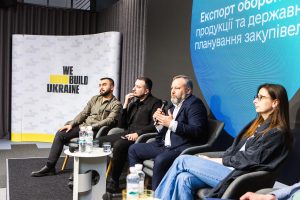
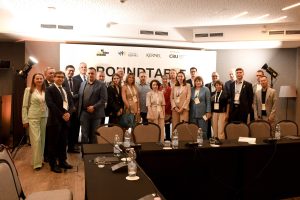
On Volunteer Day, December 5, a strategic panel discussion titled “New Defense Architecture: Business, Civil Society, Innovation” took place within the framework of the XIV Civil Society Forum. The event, organized in partnership with the We Build Ukraine think tank, gathered leading military officials, entrepreneurs, and public figures to discuss critical solutions on the threshold of 2026.

The discussion moderator, Anton Melnyk, co-founder of the defense fund MITS Capital, emphasized that the goal of the panel was not just a discussion but a “strategy session” for finding answers.

“The topic of a new defense architecture is now essentially the most important one for the survival of our country and the restructuring, and later, the reconstruction of the country after any technical cessation of the war.”
The Head of the Main Directorate of Intelligence (HUR) of the Ministry of Defence of Ukraine, Lieutenant General Kyrylo Budanov, outlined a new geopolitical reality, confirmed by the 31st anniversary of the Budapest Memorandum.

“The old world is destroyed. The democratic world must build a new defense architecture with the participation of Ukraine.”
The Head of the HUR emphasized: Ukraine’s experience in modern warfare—from the use of drones to cyber defense—is currently being studied by military theorists, inventors, and engineers in leading countries worldwide. And this experience will become the foundation for collective defense. He highlighted three key asymmetrical solutions: the system of situational unity (shared awareness), artificial intelligence in drone systems, and the development of all three drone domains (air, sea, and ground).

Mariia Berlinska, Head of the Victory Drones project, expanded the concept of the technological militarization of society as the only path to victory in conditions of unstable external support. She stressed the need to immediately implement technological education.

“A war of this scale can only be won by the entire society. Cognitive warfare, in my opinion, is the most important domain because people act according to what they believe. And wars begin and end not in the trenches, but in the heads. We must use our super-advantage—the understanding of the Russian socio-cultural code—to deprogram the enemy and direct its energy of hatred inwards toward Russia.”

Yaroslav Azhnyuk, serial entrepreneur and co-founder of The Fourth Law, presented a strategic vision for transforming Ukraine into a Global Center for Defense Innovation—the “Defense Valley.”
“Artificial intelligence is the Manhattan Project of our decade. The country, the side that can scale this system will gain a serious advantage over the enemy.”
Yaroslav Azhnyuk emphasized three directions for financing:
– Export of Ukrainian weapons and transparent intellectual property policy.
– Access to working capital (lending) for production facilities.
– State procurement critically focused on AI and Ukrainian components.
He also noted that despite the state still not fully supplying the military, and volunteers and businesses providing up to half of all drones, this movement requires systemic support.

Oleksandr Kubrakov, co-founder of We Build Ukraine, focused on the problem of business scaling and the need for a change in the state approach.

“We need normal planned work: long-term contracts, timely financing, clear logistics, and supply, so there are no failures that volunteers currently cover—then brigades will receive everything on time, at least what Ukraine produces itself. This is the only way to transform the volunteer impulse into a sustainable, professional defense industry.”
Roman “Fish” (Major, company commander of the UAV company of Lasar’s group), whose unit has destroyed over $12.7 billion worth of enemy equipment, confirmed that the key to effectiveness is small, non-bureaucratic structures and consistency.

“System defeats non-system. This applies from small processes to major work at the state level. Every serviceman must receive a drone that works ‘out of the box,’ without any additional preparation. This will solve the problem of scaling up quality.”
Lasar’s group also reported that they are actively working on a new area—the interception of enemy “Shaheds” and “Gerańs”—and have already achieved initial successful intercepts.

Kateryna Mykhalko, Executive Director of the “Technological Forces of Ukraine” Association, called on society and business to shift focus from purely internal problems to Ukraine’s role in global security and stressed the importance of the subjectivity of Ukrainian business in the international arena.

“We need to open up, provide our military experience and technology to become a full partner of the European Union, even if it doesn’t seem fair. Our industry must become professional, meet international standards, to integrate into European defense capability forever.”